

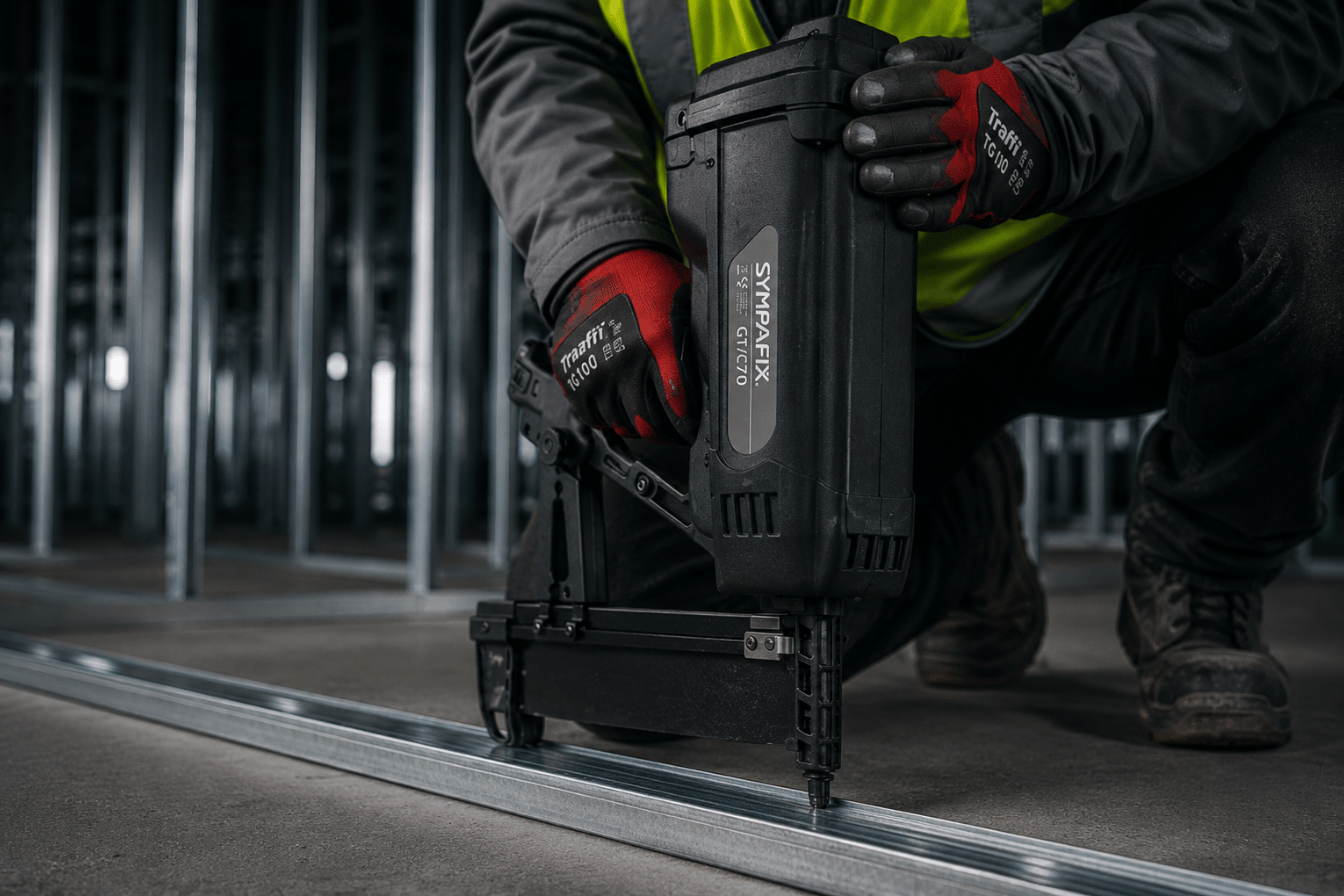
Fire-rated partitions depend on the performance of the complete assembly. That means the fixings deserve the same scrutiny as every other component.
Fire-rated partition systems have always relied on performance evidence, certification and accurate installation. What is changing is the level of scrutiny applied to every component within those systems — including the fixings.
For many years, fixing requirements were sometimes expressed through phrases such as 'approved fixings by others' or 'suitable fixings by others'. In practice, that could leave an important design detail outside the clearly defined system, with responsibility divided between the designer, contractor, distributor and installer.
Today, that lack of clarity is becoming harder to accept. The direction of the industry is towards evidence-based specification, clearer responsibility and better records of what was designed, selected and installed.
A board does not deliver fire performance on its own. The tested build-up can include boards, metal framing, insulation, sealants, jointing materials and the components that secure the system to the surrounding structure.
Fixings may be physically small, but they perform a fundamental job: they hold the construction in place. If their selection or installation differs from the evidence supporting the system, questions may arise about whether the completed build-up accurately reflects the approved design.
That is why fixings should not be viewed simply as a site consumable. In a fire-rated application, they form part of the wider system conversation.
The Building Safety Act and the regulatory changes around it have reinforced the need for people involved in building work to understand their responsibilities and maintain reliable information. For higher-risk buildings in England, official guidance describes the Golden Thread as a digital record that helps dutyholders demonstrate compliance and manage building safety.¹
The practical lesson extends beyond any single building category: important product decisions should be clear, supportable and recorded. When a fixing is left to assumption, it can become difficult to answer basic questions later:
A defined fixing strategy makes those questions easier to answer before work begins, during installation and when the project record is assembled. We cover what that record should contain in Closing the Gap Between Specification and Installation, Part 2 of this series.
A useful way to assess a fixing solution for a fire-rated system is to consider four principles:
These principles do not remove the need for competent design or project-specific assessment. They do, however, replace vague assumptions with a clearer evidence trail.
Where a fixing manufacturer has tested products and secured approval for use within defined fire-rated systems, it can give project teams a clearer route through specification, procurement and installation.
Sympafix fixings have been tested in partitions in accordance with EN 1364-1 — the European fire-resistance test standard covered in detail in What Does 'System-Tested' Really Mean for Drylining Fixings?, Part 3 of this series. Etex Building Performance has confirmed approval of Sympafix C45 and C70 gas-fired nails, SB2 concrete screws and CA Plus ceiling anchors for use within Siniat 60- and 120-minute fire-rated partition systems.²
The approval remains subject to the defined system configuration and to the products being installed and used in accordance with the manufacturer's recommendations. That qualification is important: an approved product is not a universal substitute for correct design, suitable substrates or proper installation.
For contractors, subcontractors, designers and specifiers, a better-defined fixing solution can support:
It is not about adding another layer of complexity. Done properly, it makes the process simpler by establishing the evidence, products and responsibilities earlier.
The wider industry shift is towards treating fire-rated systems as complete assemblies rather than collections of loosely connected products. Fixings are part of that shift — tested, defined, accountable and documented, in the same way as every other component in the build-up.
Because if the system is fire-rated, the fixings should be part of the conversation too.
Want more information about the approval referenced above? Contact your local GO Interiors depot and we'll help you access the relevant customer-facing approval and technical information for your project.